
By Martin Castle, Founder of MCL Height Safety
New technology isn’t always about automation or artificial intelligence (AI). Sometimes, it’s about finding a safer and more efficient way for people to reach the places machines can’t. Rope access is one of those methods, and it’s gaining ground fast in the mining world.
Once seen as a niche for industrial climbers and offshore technicians, rope access is now being recognized as a practical solution for some of mining’s toughest access challenges. Whether it’s scaling highwalls, inspecting shafts, or maintaining vertical structures, trained rope-access technicians can do it faster, safer, and with less disruption than traditional methods.
From industrial niche to mining essential
The use of rope access techniques in the mining sector is growing, and several trends and market data points underline how and why. Here’s a breakdown of how rope access is growing in mining, why it’s accelerating, and some key considerations.
- The global services market for rope access in mining applications is estimated to have been US $223.1 million in 2024, with projections to grow to about US $346.1 million by 2030 for mining-specific rope-access services.
- More broadly, the global rope-access services market (across sectors) is expected to grow from about US $3.24 billion in 2024 to US $5.19 billion by 2030.
- Another study on equipment (rather than services) estimates the rope-access equipment market at US $936 million in 2024. It’s projected to reach US $1.72 billion by 2033.
- In terms of geography: The Asia-Pacific region is showing the fastest growth for rope access services, while North America remains a major share region.
- For mining specifically: It’s being called out as an ‘emerging high-growth application area’ for rope access services.

Why mines are turning to rope access
Rope Access is a work positioning method that uses ropes, harnesses, and associated equipment to allow workers to ascend, descend, and position themselves safely while performing tasks at height or in confined spaces. In mining, it’s used for:
- Inspection and maintenance of shafts and stopes
- Scaling (removing loose rock)
- Installing ground support systems
- Repairing or cleaning vertical structures (e.g., ore passes, crushers, silos, ventilation shafts)
- Conducting geotechnical inspections
The forces powering rope access growth
Access to difficult and confined/vertical spaces. Mines often have shafts, stopes, ore passes, ventilation raises, high-walls, stockpiles, residual structures, etc., where conventional access (scaffolding, lifts, mechanical platforms) is difficult, costly or unsafe.
Rope access allows technicians to rig off anchor points and reach places otherwise hard to service, for inspection, maintenance, scaling, ground control, structural support, etc.
Safety and regulatory pressure. Mining operations increasingly face stringent safety, environmental and structural integrity requirements. Methods that reduce exposure to hazards (working at height, unstable ground, underground voids) become more attractive.
Rope access is increasingly seen as a safer alternative for certain tasks because of its flexibility, minimal footprint, and the ability to position personnel precisely with redundant rope systems.
Cost and time efficiencies. Traditional access methods (large scaffolds, heavy lifts, long shutdowns) are expensive, time-consuming and disruptive. Rope access can often be set up faster, with less material, and less downtime.

Challenges beneath the surface
While growth is strong, there are caveats and factors that will influence how quickly rope access grows in mining. These include:
- Training and certification: Qualified rope access technicians (e.g., certified under Industrial Rope Access Trade Association (IRATA) or similar) are needed. In mining, these technicians may also need mining specific credentials (underground certification, confined-space training, mining safety training). MCL Height Safety’s training meets these global standards.
- Rigging and anchor-point suitability: Mines must have appropriate anchor points, rigging infrastructure, safe drop-zones, rescue plans etc. In inaccessible or unstable ground this can be a limiting factor.
- Environmental conditions: Mines (especially underground or open pit) can have dust, vibration, water ingress, unstable rock, confined spaces, all of which complicate rope access operations compared to, say, building facade work.
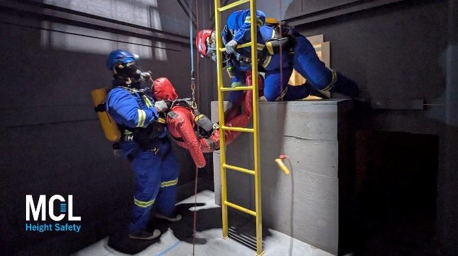
- Rescue and emergency planning: In mining, working at height or deep/underground means that rescue protocols are critical; companies must have rescue plans, which is covered within the rope access system. Have a practiced, rope-based rescue method, not just a paper plan. In 2021 at Vale’s Totten Mine (Sudbury), rope-assisted evacuation helped bring 39 miners to surface safely after a shaft blockage; that approach has since been formalized in provincial mine-rescue training. Build the same rigor into your site plans.
- Integration with trades: Often rope access is not just ‘climb and inspect’ but also works in tandem with other trades (geotechnical, blasting, ground support, welders etc.). So, the rope access provider must integrate with the mining/trade ecosystem.
Canada’s opportunity in rope access
Alberta has a strong mining and resource services sector, including oil sands, conventional mining, and service companies specializing in remote and harsh environment work. Canadian mining operations are likely to increasingly adopt rope access solutions, especially for remote sites, shaft/ventilation maintenance, and highwall scaling.
Tasks like scaling highwalls or checking ventilation raises may be prime for rope access.
Rope access also tends to require a lighter equipment footprint (advantageous in remote mine camps).
Real world safety
MCL Height Safety, based in Calgary, is part of this movement, offering IRATA-certified training, on-site consulting, and technical crews for mining and industrial clients across Canada.
MCL Height Safety ensures all technicians maintain valid certifications, complete regular recertification, and follow engineered rigging and rescue plans, ensuring total compliance and peace of mind for our clients.
All workers must complete formal rope access training and certification, and regular equipment inspection is mandatory.
Why: You’re arguing rope access is safe when planned/resourced. This incident is a vivid proof-point.

In September 2021, a scoop bucket jam at Vale’s Totten nickel mine stranded 39 miners underground. With the main conveyance down, Ontario Mine Rescue teams executed a rope-assisted evacuation: miners climbed ~4,130 feet of ladderways with support from an AZTEK rope kit rigged at intervals—every miner reached surface without serious injury. That procedure is now embedded in Ontario Mine Rescue training—clear evidence that rope systems and disciplined rescue planning save lives underground.


In another example, Rope-access crews scale and stabilize steep mine walls. At Ekati Diamond Mine (NWT), for example, Norpac’s IRATA-certified technicians perform annual pit-slope scaling and bolting entirely by ropes.
This high-angle maintenance (shown above) installs rock bolts, netting and geofabric from harnesses without heavy scaffolds. Such rope-access methods dramatically save time and cost: one industry report found 30–70% cost savings on high-height inspections versus traditional scaffolding.

About Martin Castle
Martin Castle is the founder of MCL Height Safety. The company, established in 2008, has evolved into a one-stop safety shop, specialising in IRATA rope access, Global Wind Organisation training, working at height, and rescue courses, whilst providing a working at height operation project consultancy plus offer equipment for sale.

About MCL Height Safety
Founded in 2008 as Martin Castle Ltd., MCL Height Safety has grown into a leading provider of rope access and working-at-height solutions. With over 60 years of combined training experience, it specializes in delivering industry-leading rope access services, fall protection system installations and comprehensive training programs that meet the highest safety standards.
Leave a Reply